WHAT IS AN AGENTIC GROWTH TEAM? EVERYTHING YOU NEED TO KNOW
OCTOBER 23, 2026




Getting found, and converting the traffic you already have
Pairs with: Demand gen, growth marketing
Demand capture
Turning knowledge into something a buyer wants to move through
Pairs with: Content, brand, product marketing
Buyer narrative
One validated, governed account of what the company knows
Pairs with: Enablement
Knowledge
Getting content to buyers, and keeping what reaches them on-message
Pairs with: Enablement, comms
Distribution and control
Reading every live deal and ranking what to do next
Pairs with: Sales, sales management
Deal intelligence
Diagnosing what each rep cannot yet do, and closing it
Pairs with: Enablement, management
Capability
"Isn't that just a team that uses AI?"
It is the first thing people say, and it is a fair question, because most of what gets called agentic is a tool purchase with a new adjective in front of it. Buy the software, keep the org chart, declare the team agentic.
The distinction worth drawing is between a practice and a team. The industry term you will meet more often is agentic go-to-market, which describes a way of working: agents do the production, humans direct the strategy. That is a real and useful idea, and it says nothing at all about who does what. An agentic growth team is the answer to the question it leaves open.
The short answer
An agentic growth team is a go-to-market team whose operating model assumes AI agents are part of the team rather than tools the team uses. Work is divided twice: once between people and agents, and once among the agents themselves, which specialise the way members of any team specialise. People keep judgment, relationships and the rules agents operate under.
The word carrying the weight is operating model. Not headcount, not a tool, not a reorg. It is a decision about how work divides, and it holds whether your team is six people or sixty.
Agentic GTM is a practice. An agentic growth team is an operating model
Agentic GTM describes what the agents do. An agentic growth team describes how the humans are organised around them. The first is a capability you can buy, and the second is a set of decisions about ownership, approval and accountability that no vendor can make for you.
The published definitions of agentic GTM are consistent on the practice and silent on the team. They describe agents generating content, running research, preparing for calls and removing the production bottleneck, with people moving up the stack to strategy and direction. Read several and you will find the same shape: a clear account of what the software does, and no account of who owns what afterwards.
That silence is where rollouts stall. The capability arrives, nobody has decided which actions need a human, who owns the content an agent reaches for, or what a manager now does with the time they used to spend asking reps for updates. Six months later the agents are producing and the team is working exactly as it did before, which is the expensive outcome: new cost, same throughput.
The two org charts
Here is the most useful way to hold it. An agentic growth team has two org charts that have to fit together.
The first one you already have. It has names on it, and reporting lines, and a column for marketing and a column for sales.
The second one most teams never draw. It is the chart of what the agent side covers: which jobs sit on it, which of them overlap with a human's job, and who is accountable when one of them does something unexpected. Buying agentic capability gives you pieces of that second chart. It does not draw it, and an undrawn chart is why the ownership questions have no answer six months in.
Drawing it starts with a principle rather than a product. The division between the two charts follows what each side is actually good at.
Agents take the work that is continuous, retrieval-heavy, or production-heavy. Watching every live deal every day. Remembering which of four thousand assets fits this buyer at this stage. Building the page, the deck, the brief, the follow-up. Humans do all of this and do it worse, not because they lack skill but because the work rewards tirelessness and recall rather than insight.
People take the work that is relational, consequential, or definitional. What this buyer actually cares about that nobody wrote down. Whether to hold price. Whether this deal is worth another quarter. What the rules are that the agents operate inside, and what happens when a rule turns out to be wrong.
That line is stable, and it is also not the interesting part, because it describes agents as a single undifferentiated resource. They are not. The second chart has departments too.
The six jobs on the agent side
Any serious agentic growth team has to cover six jobs, whoever supplies them. They are worth naming as jobs rather than as features, because a gap in your own second chart is easier to see as a missing function than as a missing product.

The six jobs, each paired with the human function accountable for it. Knowledge is drawn as the base the other five run on, not as a peer.
Two things fall out of that list immediately.
The first is that this is not a sales model. An agentic growth team spans marketing and sales, and three of the six jobs sit wholly or mostly on the marketing side. Teams that approach this as a sales-productivity question end up with half a chart.
The second is that the six jobs are not peers. Knowledge sits underneath the other five, because every one of them is only as good as what it is grounded in. More on that below, because it is the single decision that determines whether the rest works.
pf1, from the house of Paperflite, is organised along exactly these six lines, which is why it works as a running example through the rest of this piece. Its own framing for the arrangement is "Your Agentic Growth Team": six purpose-built agents described as "purpose-built AI for every stage of go-to-market, grounded in your company's knowledge." Whether or not you use pf1, the six jobs are the chart you have to fill.
What changes, role by role
The model is easiest to understand through what it changes for each person, because none of these are hypothetical shifts. Each one moves a specific task to the agent side of the chart and puts a different task in its place. Each one also has a failure mode, which is usually a human continuing to do the moved work out of habit.
Demand gen: from producing pages to deciding which bets to place
The marketer's unit of work stops being the page and starts being the hypothesis. Producing a landing page per campaign, a variant per segment and a registration page per event is a production constraint, and it is the reason most programmes run on three pages where they wanted thirty.
When page production moves to the agent side, the constraint becomes judgment: which segments are worth addressing separately, what the offer is, when to ask for the form and when asking costs you the visit. pf1's Lead agent builds pages around what buyers are actually searching, publishes them to be found by both search engines and AI engines, personalises per visitor, and holds the form until intent is high. Its own summary of the result is "same budget, more qualified leads," and the design principle behind the pages is "written for buyers, engineered for engines."
The shift is worth naming precisely: it is not that marketers stop making decisions about pages. It is that those decisions stop being rationed by how many pages the team can physically build.
The failure mode is a marketer who keeps the old cadence, producing three pages and treating the extra capacity as spare rather than as a different strategy. Capability without a change in ambition reads as no change at all.
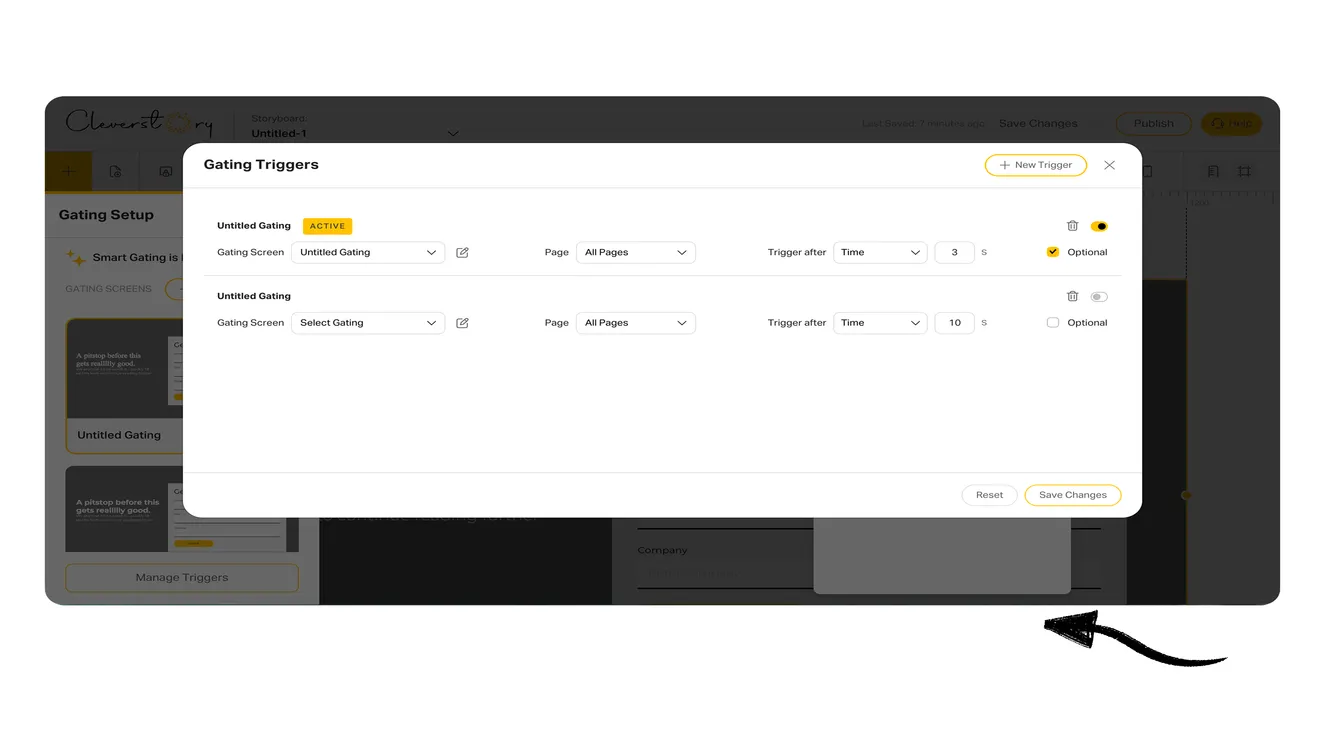
Gating rules in pf1: the conditions that decide when a visitor is asked for their details, set once rather than guessed per page.
The form appears when the buyer is ready, with only the fields that moment warrants. See it run against your own traffic.
Content and brand: from making assets to defining what good looks like
Content's output stops being the asset and starts being the standard. This is the role where the change is largest and the resistance is most understandable, because "I write things" is a clearer identity than "I define what the writing has to be true to."
What moves is composition: taking approved knowledge and arranging it into the thing this buyer needs, in brand, at the pace the pipeline asks for. pf1's Experience agent builds interactive experiences rather than flat documents, working only from approved content and the brand kit, on the premise that "knowledge is no longer a document to scroll." What stays with the human is everything that makes the output worth composing: the positioning, the argument, the proof, and the claims that are allowed versus the ones that are not.
There is a second-order effect worth planning for. When composition is cheap, the bottleneck moves upstream to the quality of what is being composed from. A thin knowledge base produces a lot of well-built pages that say very little, quickly.
The failure mode here is reviewing output asset by asset, which recreates the bottleneck one layer up. The leverage is in the standard, not the queue.
Starting a buyer experience from a prompt in pf1, composed from approved content rather than from a blank canvas.
"The team never starts from a blank page." See what it builds from your content.
The rep: from searching to deciding
The rep's day stops starting with a search box. Instead of opening the library and trying to remember which deck won a similar deal, the rep opens a queue of actions that were assembled while they were doing something else: this buyer re-opened pricing twice, this champion has gone quiet, this deal's close date is now in the past.
What this removes is recall work, which humans are genuinely bad at and which consumes a surprising share of a selling day. What it adds is judgment work. A queue of five suggested actions still needs someone to decide which two matter, what the relationship context is that the agent cannot see, and what to say.
The practical test for whether this has happened: ask a rep what they do first in the morning. "I check what came in" is the old model. "I work the queue" is the new one, and the difference in how much of their day reaches a buyer is substantial.
A pf1 action queue assembled before the rep asked: each action with the buyer signal that triggered it.
pf1's Deal agent reads every channel on every live deal, including CRM activity, emails, call transcripts and the content buyers actually open. See what it surfaces on your pipeline.
The manager: from asking for status to reading it
The weekly routine of asking six reps what happened on their deals exists because the information was trapped in people's heads. When buyer engagement is visible without anyone being asked, the one-to-one changes character: the manager arrives already knowing what happened and spends the time on what to do about it.
This is a bigger shift than it sounds, because status-chasing is most of what many managers do. Removing it does not reduce the job. It exposes the part of the job that was always more valuable and always got squeezed: coaching the rep on the two deals that are genuinely winnable, instead of collecting updates on all twelve.
It also changes what a pipeline review is for. Deal scores each open deal against the company's own win/loss history and flags the ones going wrong, on the premise that "CRM updates alone can miss what buyers are actually doing." A review that starts from a ranked list of at-risk deals with a reason attached is a different meeting from one that starts with twelve verbal updates.
The failure mode is a manager who keeps asking anyway. The information being available does not automatically change the habit, which is why this role shift is the one most worth naming explicitly when a team adopts the model.
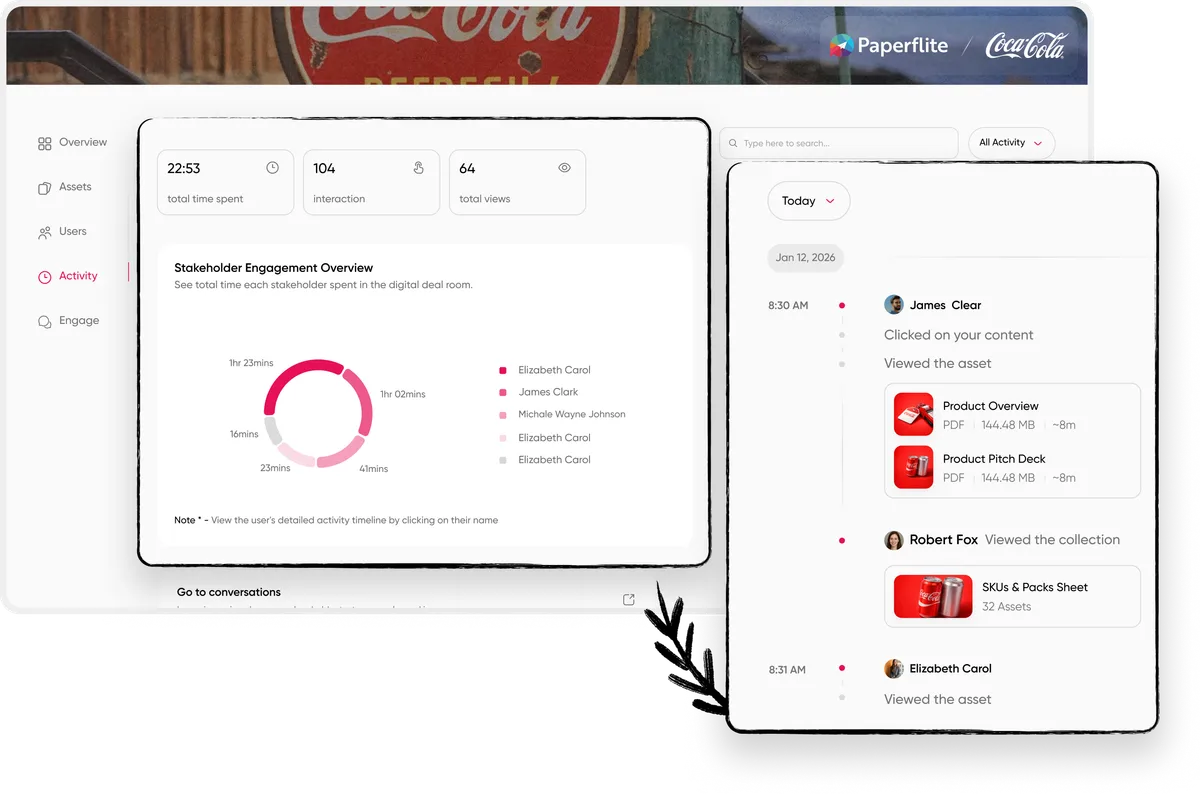
Buyer engagement visible to the manager in pf1 without a status request, which is what changes the shape of the one-to-one.
A weekly team summary assembled without anyone compiling it. See how it reads.
Enablement: from producing content to governing it
Enablement's output stops being measured in assets produced and starts being measured in whether the right thing was reachable at the right moment. That is a different job, and in an agentic model it is the more consequential one, because every agent is grounded in whatever enablement has approved.
Concretely, the work moves toward defining what is current, what is approved, what may be sent to whom, and what an agent may retrieve. Those were always good practice and could always be deferred. Once agents are reading the library, deferring them has a visible cost, because an agent acts confidently on whatever it finds. pf1's Knowledge agent is built for that job: it captures what the company knows across the systems you already run, including the processes and selling patterns top performers use but never write down, governs it in one knowledge graph, and serves it back by role, product and market with the source attached. Anything AI writes is checked against your brand, facts and claims before a buyer reads it.
An answer returned from the governed library in pf1, which is enablement's work showing up at the moment of use.
The second half of the job is the content enablement did not make. Reps build their own material, and they always will. pf1's Distribution agent exists so that can happen without losing control of what reaches buyers: rep-created content is validated against messaging rules before it is shared, with the relevant rule and a suggested fix attached to each finding. pf1 frames this as applying the same standards to rep-created content as to the official kind, which is the only version of content governance that survives contact with a real sales team.
This is also the role that gains the most leverage. A content decision made once now propagates to every agent and every rep, rather than being re-litigated in individual Slack threads about which deck is the current one.
Controls applied before a rep's send goes out in pf1, which is how rep-created content stays on-message without a review queue.
One validated source of truth, served by role, product and market. See it on your own content.
RevOps: from reporting the past to governing the system
RevOps shifts from assembling what happened to deciding what the system is allowed to do. Approval tiers, audit trails, data residency, which integrations write back and to which fields: these become the operating controls of a team that includes non-human members. pf1's own framing of this layer is "your content, your rules, your control," with approval gates, a full audit trail and data residency control built in.
The reporting does not disappear, it changes subject. The useful questions become how many agent-surfaced actions reps acted on, whether the agent retrieved the current version, and how quickly the team responded to buyer signals. Those measure whether the operating model is working, which quarterly pipeline reporting does not.
It is worth being plain that this is a governance role as much as an analytics one. Someone has to own what the agents may do, and in most teams that someone sits in RevOps whether or not the job description says so.
A content program summary in pf1: the view that tells RevOps whether the operating model is actually working.
Approval gates, audit trail and data residency, set by you rather than by the vendor. Walk through the controls.
Capability: from scheduled training to diagnosed gaps
The sixth job is the one teams most often leave off the chart, and it is the one that decides whether the other five hold. An operating model that changes what five roles do, and does nothing about whether people can do the new version of their job, is a plan with a gap in the middle.
What moves is diagnosis and practice. Instead of a quarterly training calendar built on someone's best guess, the work becomes identifying what each individual rep cannot yet do and building practice around it. pf1's Coaching agent diagnoses each rep's skill gaps and delivers practice built from the company's own deal history, builds AI buyers out of the questions and objections actually in the pipeline, and adapts based on how the rep performs. Its summary of the point is "meet the buyer before the meeting."
What stays human is the hard conversation. A readiness score tells a manager where the gap is. It does not tell them how to raise it with someone who has been missing quota for two quarters, and it should not try.
A coaching diagnosis in pf1: the specific gap for a specific rep, rather than a shared training calendar.
Practice built from the objections actually in your pipeline. See how it decides what each rep works on next.
What makes it a team rather than six tools
Six agents that do not talk to each other are six tools with an agentic label on them. The thing that makes "team" the right word is the same thing that makes it the right word for a human team: shared context, and the fact that what one member learns is available to the others.
In practice that means one body of knowledge every agent reads from and writes back to. The reading direction is grounding. The writing direction is the part most teams do not think to ask about, and it is where the compounding comes from: the topics a buyer explored, the questions they asked, the objections that recurred, the formats that held attention. pf1 describes the arrangement as "one agentic team, one source of truth," and its stack behaviour as "knowledge flows in from across your stack, and intelligence flows back into it."
The specific cross-overs are what the second org chart is for. What Lead learns about which topics a visitor explored shapes the deal room Deal opens later. What Distribution observes about engagement shapes what Coaching knows reps need to handle. A buyer question nobody could answer well becomes a gap in the knowledge layer rather than a story one rep tells in a pipeline review.
What the team searched for and could not find, in pf1: the write-back direction that turns individual gaps into a knowledge decision.
This is also why Knowledge is not simply the third item on a list. pf1 calls it "the base every agent runs on," and the argument for why is the sharpest thing on its site: "an agent that isn't grounded in your knowledge is only generating language." Ungrounded output is fluent, confident and occasionally wrong, which is a worse failure than visibly broken output because nobody catches it. The conclusion is worth sitting with: "grounded is the difference between an agent that sounds right and one that is right."
What has to be true before the model works
Four prerequisites. The first three decide whether agents are useful at all. The fourth decides whether the model compounds or plateaus.
A governed knowledge layer, because agents inherit whatever state the library is in. One current version, one owner, real metadata and permissions that mean something are not hygiene in this model, they are the mechanism by which an agent knows what it may use. What context agents need is the same list, and a single source of truth for sales content is the state you are trying to reach. This is the prerequisite most worth front-loading, because every other job on the chart is grounded in it.
Decided approval boundaries, written down before the rollout rather than discovered during it. Which actions an agent may take alone, which need a human, and what evidence would move an action from one category to the other. That last clause matters more than it looks: a boundary with no route to being revised becomes either a permanent brake or a rule everyone quietly works around.
A named owner for agent behaviour. Not a committee. When an agent does something unexpected, the question "who owns this" should have a one-word answer.
A write-back loop someone actually reads. Agents observing buyer behaviour generate a stream of signals about what buyers asked, what they could not find and what held their attention. If nobody owns acting on that, the model works at its launch-day quality forever. This is the prerequisite that separates a team improving with every buyer interaction from one that merely runs faster.
What does not change
Worth stating plainly, because the anxiety this model provokes is usually about deletion rather than division.
Relationships do not move. The reason a champion fights for you internally is not retrievable from a knowledge graph, and an agent reading every channel on a deal still cannot read what your champion said off the record.
Consequential judgment does not move. Whether to hold price, whether to walk away, whether a buyer's timeline is real: these are decisions with a cost attached, and the model deliberately keeps them on the human side of the chart.
Accountability does not move. A ranked list of at-risk deals is an input to a forecast, not a forecast. Someone still signs their name to the number.
And strategy does not move. Which markets, which segments, which problem you are claiming to solve: agents make it cheaper to execute a position and do nothing whatsoever to choose one.

The division of labour, and the four things it never touches.
How you know it is working
Six signals, and none of them is the number of agents deployed.
Reps act on what the agents surface, rather than ignoring a queue nobody trusts. Managers stop asking for status because they already have it. Enablement spends more time on what is approved than on producing the next deck. Marketing's programmes stop being sized by how many pages the team can build. Buyer response times shorten, because the gap between a signal and an action closed. And the knowledge layer is measurably better than it was a quarter ago, because someone has been reading what the agents wrote back.
If agents are producing and none of those six has moved, the capability arrived and the operating model did not, which is the most common way this goes wrong.
Recommended actions for a whole team in pf1, which is what the model looks like once it is running.
A sensible order to do this in
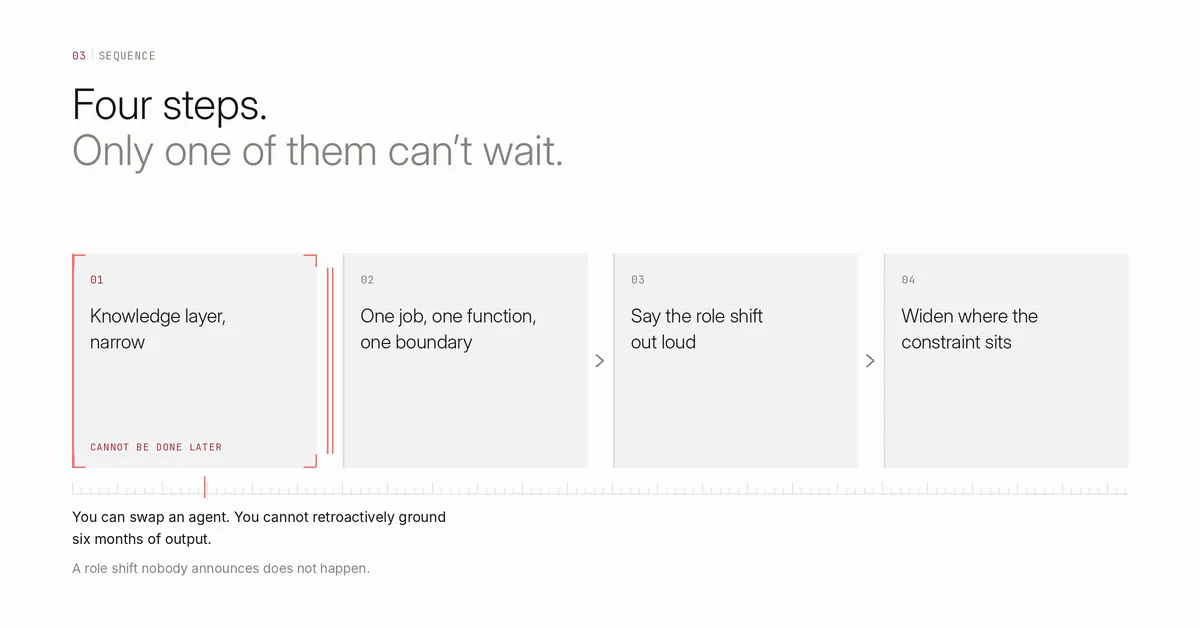
Four steps, with the only irreversible one first.
The prerequisites imply their own sequence, and it is not the sequence most rollouts follow. Most start with the agent that looks most impressive in a demo.
Start with the knowledge layer, narrow. Not the whole library. One product line or one segment, taken to the state where every asset has an owner, a current version and metadata that means something. This is unglamorous, and it is the only part that cannot be done later, because everything downstream is grounded in it.
Then add one job from the chart, scoped to the function that owns it. One agent specialism, one human function, one clearly stated boundary about what it may do alone. The point of the narrow scope is that the role shift is the hard part, and it is easier to see when only one role is shifting.
Then make the role shift explicit before adding the second job. Say out loud what the manager now does instead of asking for status, or what enablement now owns instead of production. A role shift nobody announces does not happen, because the old behaviour is always available.
Then widen, adding jobs in the order your constraint actually sits, which for most teams is knowledge first, then whichever of demand or deals is further from where it should be.
This order matters because it front-loads the only irreversible decision. You can swap an agent. You cannot retroactively ground six months of output in a knowledge layer you had not built yet.
Back to the objection
So: is it just a team that uses AI?
No, and the difference is testable. A team that uses AI has bought a capability and kept its operating model. An agentic growth team has drawn the second org chart: the six jobs are covered, each one pairs with a named human function, the boundaries are written down, and somebody owns what the agents are allowed to do.
If you can point at that chart and name which human role changed for each job on it, you have the model. If the honest answer is that the tools changed and the work did not, that is the gap, and it is an operating decision rather than a purchase.
What is an agentic growth team?
A go-to-market team whose operating model assumes AI agents are part of the team rather than tools the team uses. The work divides twice: once between people and agents, where agents take continuous monitoring, retrieval and production while people keep judgment, relationships and the rules; and once among the agents themselves, which specialise across six jobs rather than acting as one undifferentiated resource.
How is an agentic growth team different from agentic GTM?
Agentic GTM is a practice that describes what the agents do, usually production work while humans direct strategy. An agentic growth team is an operating model that describes how the humans are organised around them: who owns what, which actions need approval, and who is accountable for agent behaviour. The first is a capability you can buy, the second is a set of decisions no vendor makes for you.
What are the six jobs on the agent side of an agentic growth team?
Demand capture, buyer narrative, knowledge, distribution and control, deal intelligence, and capability. Each pairs with a human function: demand gen, content and brand, enablement, enablement and comms, sales and sales management, and enablement and management respectively. Knowledge sits underneath the other five, because every one of them is only as good as what it is grounded in.
Is an agentic growth team just for sales?
No, and treating it as a sales-productivity question is the most common way teams end up with half a model. Three of the six jobs sit wholly or mostly on the marketing side: demand capture, buyer narrative, and the distribution half of distribution and control. A growth team spans both functions, which is why the operating model has to as well.
What changes for a sales rep on an agentic growth team?
The day stops starting with a search box. Instead of recalling which asset worked on a similar deal, the rep works a queue of actions assembled from buyer signals while they were elsewhere. Recall work moves to the agent and judgment work stays with the rep: which actions matter, what the relationship context is, and what to say.
What changes for marketing on an agentic growth team?
The unit of work stops being the page and becomes the hypothesis. When page production moves to the agent side, programmes are no longer sized by how many pages the team can physically build, so the judgment calls become which segments deserve separate treatment, what the offer is, and when asking for a form costs you the visit. The failure mode is keeping the old cadence and treating the extra capacity as spare.
Does an agentic growth team mean fewer people?
It is a question about how work divides, not about headcount. The tasks that move to agents are the ones humans do poorly at scale, such as watching every deal continuously and recalling which asset fits. Relationships, consequential judgment, accountability and strategy stay with people, and the governance work grows rather than shrinks.
Who owns AI agents in a go-to-market team?
Someone should own agent behaviour by name rather than by committee, and in most teams that sits with RevOps. The role covers approval tiers, audit trails, data residency and integration write-back, because a team that includes non-human members needs operating controls as well as reporting.
What has to be in place before this model works?
Four things. A governed knowledge layer with one current version, one owner, real metadata and meaningful permissions, because agents inherit the state the library is in. Approval boundaries decided in writing before rollout, including how a boundary gets revised. A named owner for agent behaviour. And a write-back loop somebody actually reads, which is what separates a model that compounds from one running at launch-day quality forever.
Where should a team start?
With the knowledge layer, scoped narrow: one product line or one segment taken to the state where every asset has an owner, a current version and real metadata. Then one job from the agent chart paired with the one human function that owns it, then the role shift stated out loud before a second job is added. This order front-loads the only irreversible decision, because an agent can be swapped and six months of ungrounded output cannot be retroactively grounded.
How do you know the operating model has actually changed?
Six signals. Reps act on what agents surface rather than ignoring the queue. Managers stop asking for status. Enablement spends more time on what is approved than on production. Marketing's programmes stop being sized by build capacity. Buyer response times shorten. And the knowledge layer is better than it was a quarter ago. If agents are producing and none of those has moved, the capability arrived without the model.
FAQ
YOUR AGENTIC GROWTH TEAM, RUNNING ON YOUR KNOWLEDGE
SIX AGENTS. ONE SOURCE OF TRUTH.
SEE WHAT CHANGES FOR EACH ROLE ON YOUR TEAM