SALES KNOWLEDGE MANAGEMENT: WHAT IT IS AND WHY IT IS DIFFERENT
OCTOBER 26, 2026



Sales knowledge management gets filed under three things it is not. A wiki. A content library. A customer service knowledge base.
All three are storage. They assume the hard part is deciding where to put something once it has been written. In a sales organisation the hard part is that the most valuable knowledge was never written, and the people holding it are not aware they know it.
That single difference explains why most knowledge management advice fails when it reaches a revenue team, and why the frameworks in this category, which are genuinely good frameworks, were designed for a different problem.
What sales knowledge management is
Sales knowledge management is the practice of capturing, governing and serving back everything a revenue team needs in order to sell: product and technical detail, competitive positioning, pricing and process rules, and the deal knowledge held by the people who win. It differs from general knowledge management in one structural way. Most of what matters in sales is tacit, meaning it sits in individuals rather than in documents, so the difficult part is capture rather than storage.
The discipline covers four jobs: getting knowledge out of people and systems, deciding which version is authoritative, putting it in front of the right person at the moment they need it, and keeping it current as products, competitors and prices move.
The four kinds of knowledge a revenue team holds
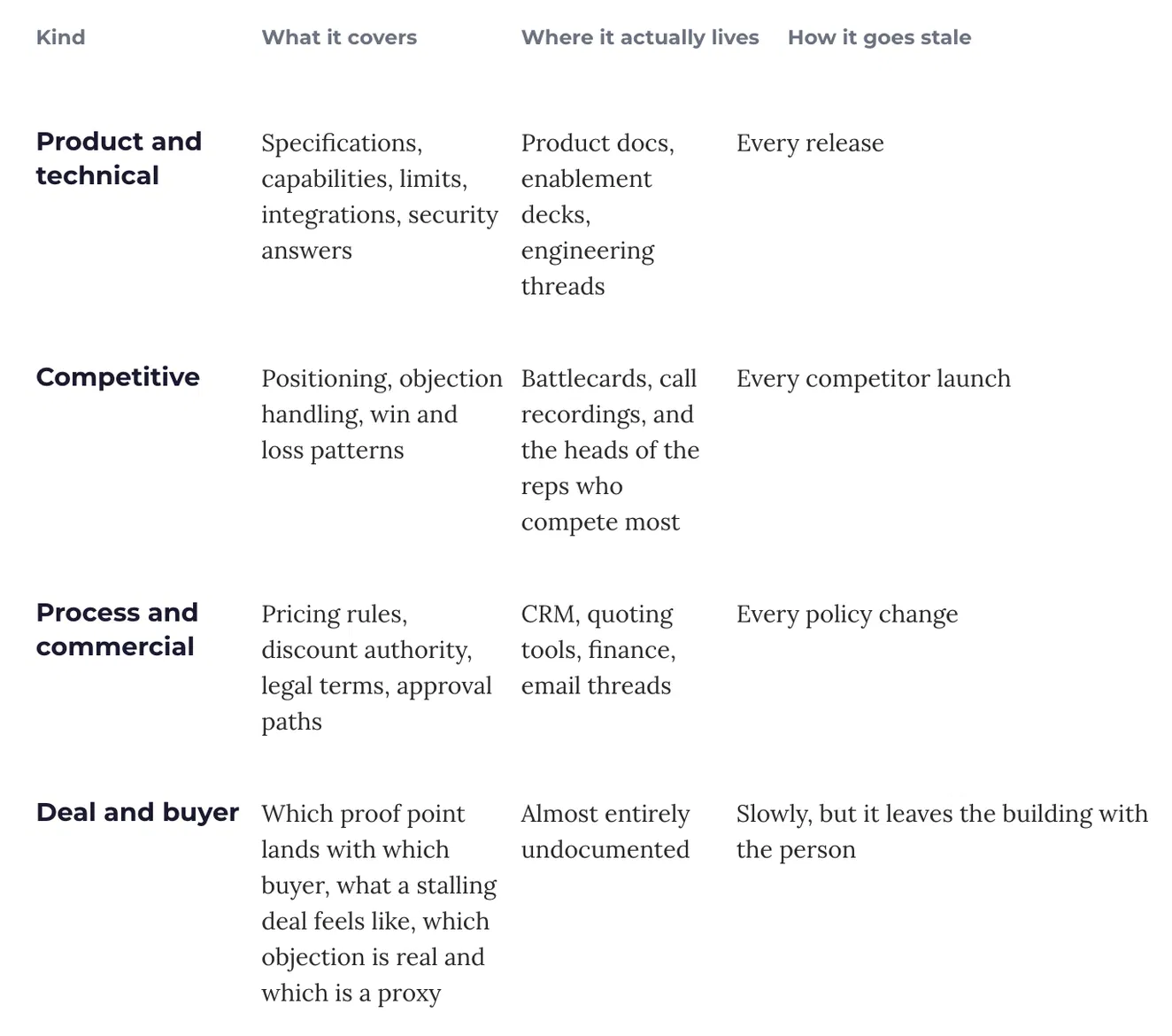
Worth separating, because they behave differently and almost no system handles all four.
The first three are explicit knowledge. They exist in a form someone else could read, even when they are scattered and out of date, so they respond to better search and tidier folders.
The fourth is tacit, and it is the one that decides outcomes. It is also the only one that walks out of the door on a Friday afternoon and does not come back.
Why the standard frameworks do not fit sales
Most published knowledge management practice inherits its assumptions from the contact centre, where the discipline matured. Those assumptions are reasonable there and wrong here.
The contact centre assumes questions repeat. A support team answers the same two hundred questions thousands of times, so writing the answer once pays for itself immediately. Sales questions arrive attached to a specific buyer, in a specific deal, at a specific stage, and the useful answer depends on all three.
It assumes answers are stable. A password reset procedure holds for a year. A competitive position can change with one announcement.
It assumes the answer can be written down. This is the load-bearing assumption, and in sales it fails. The reason your best rep wins is not reducible to an article.
None of that makes the frameworks useless. It means they describe the explicit half of the problem well and the tacit half barely at all.
The explicit half of the problem, organised. This part responds to better structure. The part that decides deals does not live here yet.
The frameworks, answered properly
Three of the questions people ask most about this topic have real answers, and one does not. Worth being precise, because the published material is inconsistent.
The four C's of knowledge management are Gartner's, from its guidance for developing a knowledge management strategy: Converse, Capture, Curate, Circulate. Converse is the one that matters most for sales, because it treats conversation as a knowledge source rather than as something that happens before knowledge is written down.
The five C's are a different list from a different author. Lucidea's version runs Capture, Curation, Connection, Collaboration, Creation. Knowledge management practitioner Stan Garfield has since compared both and produced a seven C version combining them. These are complementary rather than competing, but they are not the same framework, and a page that presents five Cs as the standard is quoting one company's model.
The five pillars of knowledge management do not trace to an originator. The phrase appears mainly in knowledge management software content, with a different list each time. If a framework matters, it can be attributed. This one cannot, which is a reasonable signal to use the four C's instead.
The five types question conflates two different things. People asking it usually mean one of two lists: the types of knowledge, where the established distinction is tacit, explicit and implicit, or the types of system, which run from document repositories to search tools to expertise directories. Answer both and the question dissolves.
The model actually worth knowing is SECI, from Nonaka and Takeuchi. It describes knowledge creation as four conversions:
- Socialisation, tacit to tacit. Knowledge moves by shared experience and observation, which in sales means ride-alongs and shadowing.
- Externalisation, tacit to explicit. Someone puts into words what they previously only knew how to do.
- Combination, explicit to explicit. Existing documented knowledge gets merged and reorganised.
- Internalisation, explicit to tacit. Someone reads the material and eventually stops needing it.
Nearly every sales knowledge programme is built around combination, because combination is what document systems do. The one that actually matters is externalisation, and it is the hardest of the four.
The problem nobody solved: getting it out of people's heads
Externalisation fails in sales for an ordinary reason. Asking a top performer to document how they sell produces a description of what they think they do, which is reliably not what they do.
The knowledge is real and it is specific. Which of four proof points to use with a sceptical technical buyer. Which objection means the deal is dead and which means the buyer is testing. When a champion has gone quiet because they are busy and when it is because they have lost internally. None of that survives the question "could you write that up for the team?"
So it stays with the individual, and the cost arrives on two schedules. The slow one is that every new hire rebuilds it from scratch. Figures cited by Highspot put 3.7 months on filling an open sales role and 9.2 months on a new seller reaching full productivity, and the second number is mostly this: the time it takes to privately reconstruct knowledge the organisation already had.
The fast one is attrition. When a top performer leaves, the organisation does not lose a quota holder. It loses the only copy of a body of knowledge, and the first anyone knows about it is when deals that would have been saved are not.
The number everyone quotes, and what it measured
Almost every page on this topic reaches for the same statistic: that between 60 and 70 per cent of content goes unused.
Two things are worth knowing before it goes into a business case. It comes from a conference talk given more than a decade ago, and it measures all content produced by B2B marketing organisations, not sales content specifically and not content that reps failed to find.
More usefully, the research firm behind it argued the cause was not findability at all. Its position was that content goes unused because it is created without real intelligence about how the buyer buys. Which means the number most often cited to justify a search problem was originally evidence of a targeting problem.
Use it to argue that content waste is real. Do not use it to size a findability gap, because it was never measuring one.
What retrieval actually changed
The shift worth understanding is from matching words to understanding meaning.
Keyword search required the person asking to use the same words as the person who wrote the document. Tagging tried to fix that by asking humans to predict future questions at the moment of upload, which is an unreasonable thing to ask of anyone. Semantic retrieval removes the requirement: a question phrased in the buyer's language can reach a document written in the company's.
The larger change is what is now capturable. Calls, threads and meetings are unstructured, and they are precisely where tacit knowledge surfaces naturally. A rep who would never write a document about handling a pricing objection handles one out loud every week. Systems that can read those sources can externalise knowledge their owners were never going to type.
Three failure modes survive the upgrade, and they are the ones to design against:
Stale sources answer confidently. A retrieval system has no opinion about whether a document is current. It will quote last year's pricing with the same assurance as today's.
Permissions get flattened. Making everything findable is not the goal if some of it should not reach everyone.
Conflicting versions produce conflicting answers. Where four versions exist, a system can return any of them, and the reader has no way to tell which is authoritative.
An answer returned with its source attached. The attachment is the part that makes it checkable rather than merely fluent.
Run a quick test on your own library: take the ten questions your team answers most for buyers and see how many return one current answer with a source. We will run that set with you and you keep the findings.
One answer, not four versions
Which makes governance the unglamorous half of this discipline and the half that decides whether any of it works.
Three decisions do most of the work. Which version is authoritative, named explicitly rather than implied by a folder. Who owns each area of knowledge, by name, with the authority to retire things. And what happens when something changes, meaning whether the old version disappears or quietly survives alongside the new one.
Systems that answer questions rather than return lists raise the stakes. A search result that looks wrong gets ignored. An answer that sounds authoritative gets repeated to a buyer. A single source of truth for sales content stops being a tidiness preference at that point and becomes a precondition.
This is also where the agent question lands. AI agents fail on what they cannot see, and the thing they cannot see is usually not missing. It is present in four versions with no indication of which one is current.
Where pf1 fits
pf1, from the house of Paperflite, is an agentic growth team, and the agent that addresses this directly is Knowledge. Its stated job is the externalisation problem: capturing everything the company knows, written and unwritten, spoken and unspoken.
In practice that means four things that map onto the sections above.
The design premise is worth stating plainly, because it is the difference between a system that sounds right and one that is right: every other agent on the team reads from that graph and writes back into it, so what the organisation knows improves through use rather than decaying between updates.
Knowledge work is hard to manage because it is hard to see. A program view is what makes the question answerable weekly rather than annually.
Bring the questions your team gets wrong most often and we will show you which ones your own content answers cleanly today. Walk through it with us.
How to start
Three moves, in order, and none of them begins with buying something.
Start with the questions, not the documents. Collect the twenty questions reps actually ask internally in a month. That list is your scope, and it will look nothing like your folder structure.
Name an owner per area before you name a system. Product knowledge, competitive, commercial, deal. Ownership without a system beats a system without ownership, every time.
Capture one tacit thing properly. Pick the objection that stalls the most deals, get three people who handle it well into a room, record it, and turn that into something reusable. It is the smallest possible version of externalisation, and doing it once tells you more about your knowledge problem than any audit.
The organisations that get this right are not the ones with the best search. They are the ones that treated what their best people know as an asset worth capturing before that person resigned.
What is sales knowledge management?
The practice of capturing, governing and serving back everything a revenue team needs in order to sell: product and technical detail, competitive positioning, pricing and process rules, and the deal knowledge held by the people who win. It differs from general knowledge management because most of what matters in sales is tacit, meaning it sits in individuals rather than documents, so the hard part is capture rather than storage.
What are the four C's of knowledge management?
Converse, Capture, Curate and Circulate, from Gartner's guidance for developing a knowledge management strategy. Converse is the one most relevant to sales, because it treats conversation as a source of knowledge rather than as something that happens before knowledge gets written down. Note that a five C version from Lucidea and a seven C version compiled by Stan Garfield also circulate, so check which list a given source is using.
What are the 5 pillars of knowledge management?
There is no established five pillars framework with a traceable originator. The phrase appears mainly in knowledge management software content, and the five items differ from one source to the next. If you need a framework to structure a programme around, Gartner's four C's can be attributed and the five pillars cannot.
What are the five main types of knowledge management?
The question usually conflates two different lists. If you mean types of knowledge, the established distinction is tacit, explicit and implicit. If you mean types of system, the common groupings are document repositories, search and retrieval tools, collaboration platforms, learning systems and expertise directories. Most published five-type lists are one of these two, written without saying which.
What is an example of a KMS?
A knowledge management system is any system that captures, organises and serves organisational knowledge. Common examples are an internal wiki, a document repository, a customer service knowledge base, a learning management system and an enterprise search tool. In a sales context the relevant example is a system that unifies capture across the tools a revenue team already uses and serves answers by role and situation, rather than one that stores documents and relies on people finding them.
What is the difference between tacit and explicit knowledge?
Explicit knowledge can be written down and transferred by reading it, such as a specification or a pricing rule. Tacit knowledge is held by a person through experience and resists documentation, such as knowing which objection signals a dead deal. Implicit knowledge sits between the two: it could be written down but nobody has. Most sales knowledge that decides outcomes is tacit, which is why document systems alone do not solve the problem.
What is the SECI model?
A model of knowledge creation from Nonaka and Takeuchi describing four conversions: socialisation, where tacit knowledge passes between people through shared experience; externalisation, where tacit knowledge is put into words; combination, where existing explicit knowledge is merged and reorganised; and internalisation, where documented knowledge becomes personal skill. Most sales knowledge programmes focus on combination because that is what document systems do, while externalisation is the one that actually matters.
How is sales knowledge management different from a wiki?
A wiki assumes the knowledge has already been written down and the problem is where to put it. Sales knowledge management has to deal with the fact that the most valuable knowledge was never written down, is held by individuals who may not realise they hold it, and changes with every release, competitor launch and pricing decision. Storage is the easy half.
Who should own sales knowledge management?
Ownership works better split by area of knowledge than assigned to one team wholesale. Product knowledge usually sits with product marketing, competitive with whoever runs win and loss analysis, commercial with sales operations, and deal knowledge with enablement or frontline management. What matters is that each area has a named owner with the authority to retire things, because unowned knowledge accumulates rather than improves.
How do you measure sales knowledge management?
Deliverable counts and article volume measure activity rather than outcome. More useful measures are whether a question returns one current answer rather than several, how long it takes a rep to get an answer they can send to a buyer, new hire ramp time, and whether produced knowledge actually reaches buyers. All of them require the output to sit somewhere instrumented.