DIGITAL SALES ROOM GUIDE: WHAT IT IS, WHAT GOES IN ONE, AND WHO OWNS IT
OCTOBER 27, 2026
A digital sales room is one private web page where everyone involved in a purchase finds everything about that deal: the proposal, pricing, security answers, call recordings and the plan to reach a decision. One link, shared by the rep, updated as the deal moves.
Most guides stop at that definition. The two questions that decide whether a deal room earns its keep are what actually goes in one, and who is responsible for keeping it current. This covers both, plus how to tell buyers are using it.
What goes in one
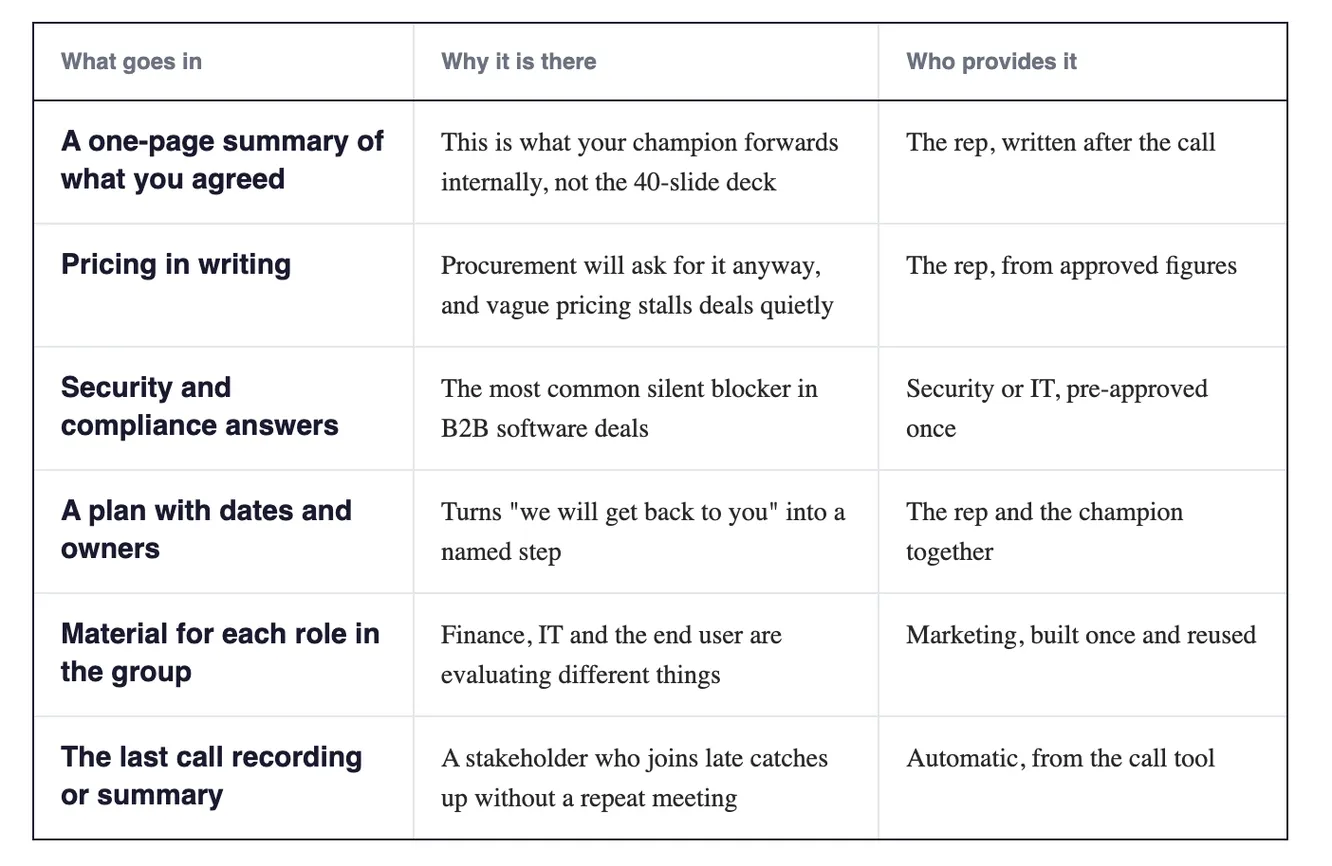
Start here, because a deal room with the wrong contents is just a tidier folder.
Two rules of thumb. If a buyer would have to email your rep to get it, it belongs in the room. If it only exists to impress, it does not.
Why buyers expect one now
The behaviour driving this category is well documented, and it is not a preference for software.
A Gartner survey of 646 B2B buyers, published in 2026, found 67 per cent prefer a rep-free experience and 45 per cent used AI during a recent purchase. Buyers are working through evaluation with fewer early seller conversations than they used to.
That is the problem a deal room addresses. Most of the evaluation now happens in rooms your rep is not in, on days nobody tells them about. A deal room does not get the rep back into those conversations. It makes sure the right material is there when they happen, and reports back on what was read.
One more figure from the same survey is worth holding onto: buyers who felt confident in their decision were twice as likely to report a high-quality deal. The job is not to be present for every conversation. It is to make the buyer confident enough to finish one.
What is a digital sales room, exactly?
It helps to say what it is not, because three different things share the name.
A shared folder is not a deal room. A folder holds files. A deal room has structure, an owner, and tells you what the buyer did. Dropping links in a folder gives you none of the signal, which is the part that matters most.
A content microsite is not a deal room. Microsites are usually marketing-owned and built one-to-many for a campaign or a segment. A deal room is sales-owned and built for one opportunity, which changes who maintains it and how long it lives. The two overlap in technology and barely at all in purpose.
A virtual data room is a different product entirely. If you search "deal room" you will mostly find data rooms for mergers, acquisitions, fundraising and property transactions. Those are built for secure document disclosure and legal diligence. A digital sales room is built to help a buying group reach a decision. Same phrase, different category, different buyer.
The plan inside the room
The component that changes a deal room from a library into a working document is the one most rooms leave out: a written plan showing what happens between now and a decision, with dates and names against each step.
It gets called a mutual action plan, a close plan or a success plan. The idea is the same. Both sides agree the sequence, so "we need to talk internally" becomes "legal review, Thursday, with Priya".
It belongs inside the room rather than in email, because every stakeholder can see it and nobody has to ask for the latest version. When a date slips, everyone sees it slip, which is uncomfortable and useful.
Who owns it
This is the question the category talks about least and the one that decides most.
Forrester's assessment of digital sales rooms is worth reading before you buy one. Their verdict is mixed rather than enthusiastic: these tools are not a magic wand, and inadequate onboarding leads to random seller adoption, low buyer engagement and little realised value. "Random seller adoption" is an ownership failure described in three words.
The arrangement that holds up splits ownership in two.
Centrally owned: the template, the approved security pack, the pricing format, the role-based material, and the rule for what has to be in a room before it is shared. This belongs to enablement or marketing, built once.
Rep owned: the instance. The summary of this call, this plan, these dates, this stakeholder. No central team can keep a hundred live rooms current, and a room nobody updates is worse than no room at all, because the buyer stops trusting it.
If nobody can name the owner of each half, the rollout is already in trouble.

Access settings decide who can open the room and what happens when it is forwarded, which is the first thing to agree when a template is handed to reps.
How to tell buyers are actually using it
Most reporting in this category counts views. Views tell you almost nothing, because one champion refreshing a page six times looks identical to six people reading it once.
Four signals are worth more than any view count.
How many distinct people opened it. A buying group is several people. If only your champion ever opens the room, you do not have a buying group yet, you have one interested person doing you a favour.
Whether anyone new appeared. A name you have not met opening the room is the single most useful event in the data. It usually means the deal just moved inside their organisation, and it often arrives before anyone tells your rep.
What they returned to. One visit is interest. Going back to the pricing page twice before a committee meeting is a different signal, and it tells your rep what the meeting is about.
What they skipped. If nobody has opened the security pack a week before a security review, that review is going to go badly.
The practical test for any platform: can it tell you who, from which company, looked at what, more than once? If the answer is a chart of total page views, you are not buying the signal.
Why deal rooms fail
Forrester names four dynamics that reduce results, and all four are worth checking before signing.
Sales and marketing are not aligned on what the room is for, so it ends up stuffed with campaign content the buyer did not ask for.
The setup is too weak for personalisation to do anything, which turns a deal room into the same page for everybody.
Privacy rules limit what you can collect, which matters more if you sell into regulated industries or across regions. Worth asking what engagement data is captured and where it sits before procurement asks you.
Onboarding is inadequate, so adoption is random, buyers see half-built rooms, and the tool quietly becomes shelfware.
Notice that three of the four are about how you run it rather than what you bought.
Where pf1 fits
Two problems run through everything above. Rooms are costly to assemble, which is why so many sit half-built. And once they exist, they produce activity somebody still has to interpret.
pf1, from the house of Paperflite, is an agentic growth team, and two of its agents sit either side of that.
Building the room. Look again at the table near the top: six components, from five different owners. That assembly cost is the real reason a rep reuses last quarter's room or skips it. Experience is pointed at this, and sales proposals and deal rooms are named use cases on its page. Its stated behaviour is that one line carries the whole brief. The agent reads your intent, reviews your approved knowledge, applies your brand kit and generates the pages, with what it produces checked automatically against skills built for your business, so what ships is on-brand and compliant.
That changes the ownership split described earlier more than it looks. The central half stops being a maintenance queue, because the approved security pack, the pricing format and the brand rules live in the knowledge the agent builds from. A rep opening a room for a new deal is not hunting for the current version of anything, which is the step where most rooms go stale.

Reading what happens in it. The second half is the signal. Deal is pointed at knowing which deals are in trouble and what reps should do next, by comparing live deals against your own win and loss history. The line on its page is the relevant one here: CRM updates alone can miss what buyers are actually doing.
That is the gap a room exposes and rarely closes by itself. The room produces engagement signals. Someone still has to judge whether a champion going quiet for nine days matters on this deal, given how your deals usually run. Deal checks buyer activity across channels, investigates the evidence and compares similar deals, so the signal arrives as a judgement rather than as one more chart for a rep to read between calls.

Session-level reporting shows who opened what and how often, which is the raw material for deciding whether a deal is progressing or stalling.
Before you roll one out
Three things to settle, in this order, and none of them is a feature comparison.
Decide what has to be in a room before a rep can share it. Write the list. It is shorter than you think and it is the whole quality bar.
Name the owner of each half. Template and standards centrally, instance with the rep. Put it in writing, because "everyone owns it" means nobody updates it.
Agree what signal you will act on. Pick one, such as a new name from the buying group opening the room, and decide now what a rep does when it happens. A signal nobody acts on is a metric, not a signal.
Then roll it out to a handful of deals rather than the whole team. The failure mode Forrester describes is random adoption, and that is far easier to prevent on five deals than to repair across fifty.
What is a digital sales room?
A digital sales room is one private web page where everyone involved in a purchase finds everything about that deal: the proposal, pricing, security answers, call recordings and the plan to reach a decision. The rep shares a single link and updates the page as the deal moves, so the buying group always has the current version. It differs from a shared folder because it has structure, an owner, and reporting on what the buyer actually opened.
What should go in a digital sales room?
A one-page summary of what was agreed, pricing in writing, security and compliance answers, a plan with dates and owners, material aimed at each role in the buying group, and the most recent call recording or summary. Two rules of thumb: if a buyer would otherwise have to email your rep for it, it belongs in the room; if it only exists to impress, it does not. A room with the wrong contents is just a tidier folder.
What is the difference between a digital sales room and a virtual data room?
They are different products that share a name. A virtual data room is built for secure document disclosure and legal diligence in mergers, acquisitions, fundraising and property transactions. A digital sales room is built to help a B2B buying group reach a purchase decision, so it prioritises clarity, personalisation and engagement reporting over controlled disclosure. Searching "deal room" mostly returns data rooms, which is worth knowing when researching the category.
Who owns the digital sales room internally?
Split it. The template, approved security pack, pricing format and role-based material belong centrally with enablement or marketing, built once and maintained as standards. The individual room belongs to the rep running that deal, because no central team can keep dozens of live rooms current. Forrester notes that inadequate onboarding produces random seller adoption and little realised value, which is an ownership failure rather than a product failure.
How do you measure whether a digital sales room is working?
Ignore total views, which cannot distinguish one person refreshing six times from six people reading once. Four signals matter more: how many distinct people opened it, whether anyone new from the buying group appeared, what they returned to more than once, and what they skipped entirely. A new name opening the room is usually the most valuable event in the data, because it means the deal moved inside the buyer's organisation before anyone told your rep.
Do buyers actually want a digital sales room?
The behaviour behind the category is well documented. A Gartner survey of 646 B2B buyers, published in 2026, found 67 per cent prefer a rep-free experience and 45 per cent used AI during a recent purchase. Buyers are progressing through buying tasks with fewer early seller interactions, which means much of the evaluation happens where your rep is not present. A deal room is one way to remain useful during that stretch rather than absent from it.
What does digital sales room software actually do?
Three things, at minimum. It hosts a branded page per opportunity that a rep can assemble quickly from approved material. It controls access, so the room can be forwarded inside the buying group without leaking to anyone else. And it reports engagement at the level of the individual visitor rather than the page, which is what turns the room from a delivery mechanism into a source of deal signal. Anything beyond those three is preference.