ANSWER ENGINE OPTIMIZATION GUIDE: WHAT EARNS AN AI CITATION
OCT 27, 2026
Answer engine optimization is getting cited when an AI answers a question, instead of getting clicked in a list of links.
A model is describing your product to buyers right now, and it never asked you anything. It builds that description out of reviews, forum threads, a comparison post by someone who has never opened your product, and your own website, which counts for less than you would hope.
AEO is the work of getting into that description and being accurate once you are there. It sits on top of SEO rather than replacing it: ranking puts you in the candidate pool, and something else decides who gets quoted.
The click stopped being the point
Pew Research Center tracked nearly 69,000 Google searches across 900 US adults. When an AI summary appeared, people clicked a standard result 8 per cent of the time, against 15 per cent when no summary was present. Clicks on a source link inside the summary ran at about one per cent.
Pew is a research organisation with nothing to sell in this category, which is why that number is firmer than most of what circulates about AI search.
Read those figures as a buyer rather than as a marketer and they get uncomfortable. Someone can learn your positioning, weigh you against two competitors and build a shortlist without ever landing on your site. The visit you have spent years optimising for is now optional.
Ranking makes you eligible, not cited
Traditional SEO still does real work for Google's AI layer. You have to be indexed and ranking to enter the candidate pool at all.
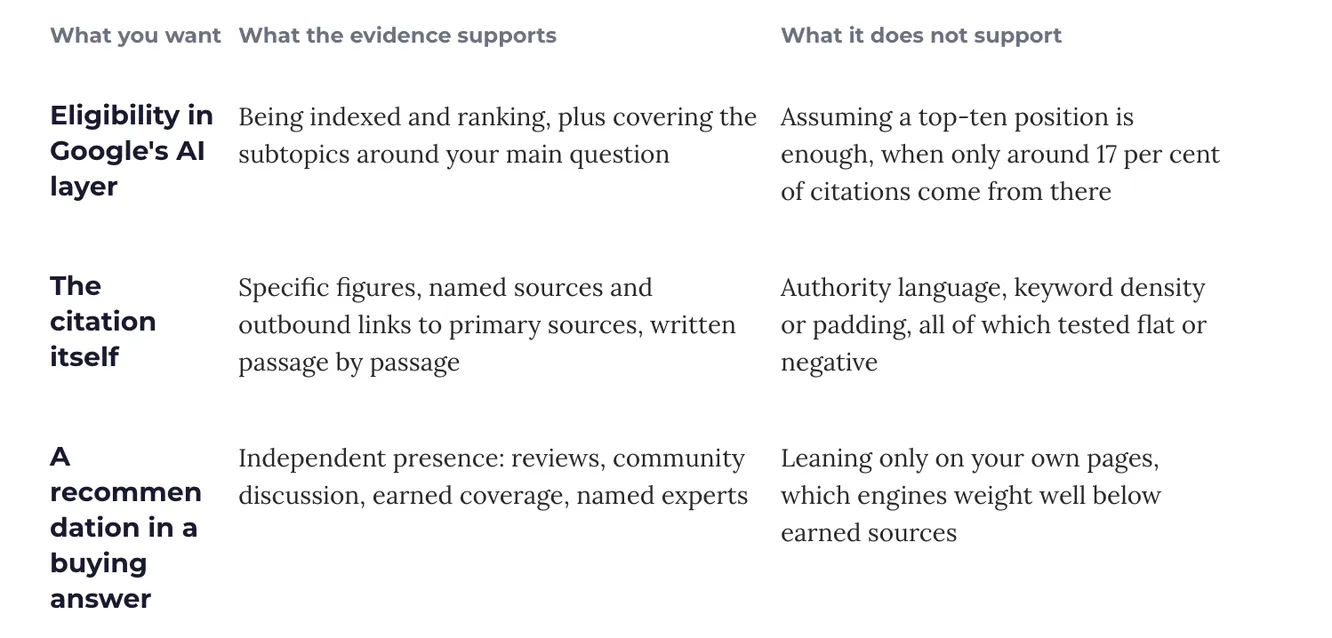
Qualifying is where most teams stop, and it is not where the citation happens. BrightEdge, which sells SEO and AI-search tooling and so has a stake in how this story gets told, found that only around 17 per cent of AI Overview citations come from pages ranked in Google's organic top ten. They do not publish a sample size, so treat it as directional.
Everything else comes from pages that answer one specific sub-question better than anyone else, wherever those pages happen to sit. A page at position 40 can turn up in an AI Overview if it holds the sharpest answer to a question the system asked itself.
It asks itself quite a few. Google describes a "query fan-out" technique that issues multiple related searches at once across subtopics and data sources, then pulls the results together into one response. Google does not publish how many, and the specific counts you will see quoted around the web are not its figures.
So the unit of work shifts. You are no longer tuning a page against a keyword. You are writing passages that answer questions you never chose to target.
What actually earns a citation
Here the evidence improves, because it stops coming from the tooling market and starts coming from universities.
A team from Princeton and collaborating institutions built a benchmark of 10,000 queries across 25 domains, then rewrote content nine different ways to see which rewrites got cited more. The work was published at the KDD conference.
Three rewrites worked: adding specific numerical statistics, adding quotations from named sources, and adding outbound citations to credible primary sources. Visibility rose by up to 40 per cent, and for pages sitting fifth in the candidate set, adding source citations lifted visibility by 115.1 per cent.
That 115 is the number everyone repeats and almost nobody qualifies, so here are the qualifications. These are per-method, per-domain maximums rather than average effects. On live Perplexity the biggest gain was closer to 22 per cent. And a result measured inside a benchmark is a finding, not a promise about your page.
The failures are worth as much as the wins. Keyword stuffing did nothing, and sometimes made things worse. Authoritative-sounding prose with no data behind it, padding, and simplifying the language without adding anything all landed flat or negative.
Strip it down and the lesson is unglamorous. A retrieval system cannot see your adjectives. It can see a figure, a date, a named person and a link to something checkable.
Which explains the finding people find hardest to accept: linking out to other sources helps you. Citing a credible primary source is evidence your claim rests on something, and the reranker treats it that way.
Most of it does not happen on your website
Now the part that quietly rearranges your budget.
Researchers at the University of Toronto pushed more than 1,000 consumer queries across ten industry categories through ChatGPT, Perplexity, Gemini and Claude, then compared what those engines cited against Google's results for the same questions. Earned sources were cited at roughly four and a half times the rate of brand-owned and social sources combined. In US automotive, the split ran 81.9 per cent earned against 18.1 per cent brand-owned. Google, asked the same things, gave brand-owned pages 39.5 per cent.
Those were consumer queries rather than B2B software ones, so take the ratio as indicative and not as your number.
The direction holds regardless, and it is structural rather than incidental. An engine answering "which tool should I use" treats a company describing its own product as an interested party. It leans on independent agreement instead. It behaves like a cautious buyer who would rather hear from three strangers than read your pitch, which is roughly how your buyers behave too.
Review profiles, community threads, analyst coverage and named people publishing under their own byline are not a separate marketing activity that happens near AEO. On evaluative and comparison questions they are most of it.
Where to spend the effort
The same handful of habits keeps showing up in pages that get lifted:
A direct answer in the first 200 words. Thirty to fifty words that settle the core question on their own. If a system grabs that passage and nothing else, it should still be worth reading.
One question closed per section. Sections that resolve a single question beat sections that wander around a theme. It is also why FAQ blocks do so well: somebody already cut them to size.
Two specific statistics with linked sources, minimum. Not ranges. Not "significant improvement". Your own original data is worth most of all, because it exists nowhere else and no model has it.
Comparison data in real HTML. Specifics trapped inside an image or a screenshot may as well not exist.
Nothing load-bearing behind a form or a script. Crawlers do not fill in forms, and plenty never run your JavaScript.
Is this just SEO with a new name?
Partly. That answer annoys both camps, which is usually a sign it is about right.
Plenty of what gets sold as an AEO revolution is ordinary SEO in a new outfit. Clear writing, direct answers, credible sources, sensible structure. That has been the job for twenty years.
Three things did change. The unit moved from the page to the passage, so a sharp paragraph inside a mediocre article can get cited while a limp opening gets a strong page filtered out. The goal went binary, because there is no position three inside a synthesised answer. And third-party agreement now counts as its own credibility signal, separate from link authority.
You are not starting over. You are adding a layer.
How to measure it without fooling yourself
AI answers are probabilistic. Ask the same question twice and you can get two different answers citing two different sets of sources. One screenshot of a flattering response proves almost nothing, which has not stopped anyone from putting it in a board deck.
Work published in 2026 put numbers on the problem. Across 30 platform-and-topic tests, rankings of the most-cited sites needed somewhere between 33 and 94 cited answers before they settled, and a few had not settled after 125 questions. That preprint comes from the founder of an AI-visibility software company, so it carries the same caveat as any tooling research, but researchers at the University of St. Gallen landed in the same place independently on a different dataset.
For a small team, the sustainable floor is a few runs per priority question across two engines, reported monthly rather than weekly. A month of rough data beats a week of perfect data, mostly because you will still be doing the rough version in March.
Three things worth tracking: how often you show up across runs, whether the description of you is accurate when you do, and whether you appear beside the companies your buyer is already weighing.
Try this on your own category
Search the term you most want to own. Compare the sources inside the AI Overview against the organic results sitting underneath it. Then ask the same question in ChatGPT and compare again.
Those three lists usually overlap less than people expect. Run it three times before you conclude anything, since a single run is noise.
Then count how many of those citations are yours. For most companies the count is zero, and zero is a perfectly good place to start measuring from.
Where pf1 fits
pf1, from the house of Paperflite, is an agentic growth team, and the agent pointed at this problem is Lead. Its stated job is increasing brand discovery through AEO and SEO, personalising pages to the visitor, and capturing the form fill when intent is high.
The mechanism matters more than the label. Lead detects the terms buyers search and builds pages from your approved knowledge, published with llms.txt and markdown so engines read them as readily as people do. The line on its page puts the requirement well: written for buyers, engineered for engines.
Two things follow from the research above. Pages built from approved knowledge carry the specifics that survive reranking, rather than the general claims that get filtered out. And because every agent on the team reads from the same knowledge graph and writes back into it, your description of yourself stays steady between the page a buyer lands on and the answer a rep gives.
That last point is the quiet requirement under all of this. A system writing an answer about your category reconciles several sources at once. Describe yourself three different ways across three places and there is nothing stable for it to quote.
What to change this quarter
In order of how much evidence sits behind them.
Put a direct answer block in the first 200 words of your strongest pages. Thirty to fifty words, self-contained, settling the question the page exists to settle. Cheapest change on this list with the clearest research behind it.
Get specific numbers and linked sources into those pages. Statistics, named quotations and outbound citations are the three rewrites that actually tested positive. Your own data is worth the most, because no model can already know it.
Build the third-party footprint on purpose. Review profiles, real participation where your buyers talk, named people publishing under their own byline. On evaluative questions this is where most citations come from, which makes it a line item rather than an afterthought.
Check that crawlers can reach you at all. Search crawlers and training crawlers are different things, and blocking the wrong one can remove you from a platform outright. Anything that matters belongs in the initial HTML, not behind a form or a script.
Then measure across multiple runs, report monthly, and treat any single answer as an anecdote. Most companies start at zero. The ones who end up owning this are the ones who started counting while the method was still unsettled.
What is answer engine optimization and why is it important?
Answer engine optimization is getting cited when an AI answers a question, instead of getting clicked in a list of links. It is a visibility layer on top of SEO rather than a replacement for it. It matters because the click is no longer the main outcome: Pew Research Center found that when an AI summary appeared, people clicked a standard result 8 per cent of the time against 15 per cent without one, and clicked a link inside the summary about 1 per cent of the time. Being quoted in the answer is the win.
What actually makes content more likely to be cited by AI?
Research presented at the KDD conference tested nine ways of rewriting content across a benchmark of 10,000 queries. Three worked: adding specific numerical statistics, adding quotations from named sources, and adding outbound citations to credible primary sources. Visibility rose by up to 40 per cent, and for pages sitting fifth in the candidate set, adding source citations lifted visibility by 115.1 per cent. Those are per-method maximums rather than averages. Keyword stuffing, authoritative tone without data, padding and simplified language all tested flat or negative.
Why do AI engines cite other websites instead of mine?
Because they weight independent sources far above brand-owned ones on evaluative questions. University of Toronto researchers ran more than 1,000 consumer queries through four AI engines and found earned sources cited at roughly four and a half times the rate of brand-owned and social sources combined. In US automotive the split was 81.9 per cent earned against 18.1 per cent brand-owned, where Google gave brand-owned pages 39.5 per cent on the same queries. Review profiles, community discussion and earned coverage are part of the work rather than adjacent to it.
Is AEO just SEO with a new name?
Partly. Clear writing, direct answers, credible sources and sensible structure have been the job for years. Three things did change: the unit moved from the page to the passage, so a sharp paragraph in a weak article can be cited; the goal went binary, because there is no position three inside a synthesised answer; and third-party agreement now counts as its own credibility signal rather than only as link authority. You are adding a layer, not starting over.
What is the difference between AEO and GEO?
Answer engine optimization is the older term. It grew out of optimising for featured snippets and People Also Ask boxes, and it emphasises structuring content so a system can pull out a direct answer. Generative engine optimization is newer and was formally defined in academic research. It emphasises being one of the sources an AI draws on while writing a multi-paragraph response. AEO is about being the answer. GEO is about being in the answer. Day to day they describe the same work.
How do you measure whether AEO is working?
Across multiple runs, never once. AI answers are probabilistic, so the same prompt can return different brands and different sources each time. Work published in 2026 found that rankings of the most-cited sites needed between 33 and 94 cited answers before settling, and some had not settled after 125 questions. For a small team, a few runs per priority question across two engines, reported monthly, is the sustainable floor. Track how often you appear, whether the description of you is accurate, and whether you show up beside the companies your buyer is already weighing.