AGENTIC REVENUE ENABLEMENT STRATEGY: CONTEXT, WORKFLOWS, AND GOVERNANCE
OCTOBER 14, 2026




A rep asks the AI assistant for the latest security deck to send a fintech buyer. The assistant answers in two seconds, with total confidence, and links a deck that was retired two quarters ago. It also tacks on a pricing claim that legal never approved. The tool did its job. What was missing was an agentic revenue enablement strategy: a decision about what the agent should know, what it should do, and what it must never touch without a human.
Plenty of teams bought the agents first and made those decisions later (or never). This guide gives you a three-part structure for making them up front: context, workflows, and governance. It is written for enablement, RevOps, and sales leaders who are piloting AI agents or about to, and it ends with a 90-day plan you can start on Monday. Along the way you will see where revenue enablement programs usually break once agents enter the picture.
What Is Agentic Revenue Enablement?
An agentic revenue enablement strategy is a plan for putting AI agents to work on enablement tasks such as content discovery, deal prep, coaching, and follow-up, with three parts in place: trusted context for agents to draw on, defined workflows they own or assist, and governance that sets limits, approvals, and audit trails.
Agentic enablement uses AI agents that watch signals, choose a next step, and act inside the tools your team already works in, while a person stays accountable for the outcome. A generative AI assistant waits for a prompt and returns text. An agent works toward a goal, which is the difference between a recipe app and a meal kit service that orders the ingredients, schedules delivery, and swaps an item when the store runs out.
The word "revenue" matters here. Sales-only programs stop at the rep, while a revenue program covers marketing, customer success, and RevOps too, so agents can serve every team that touches a buyer. If you want the full comparison, we break it down in revenue enablement versus sales enablement.
Seismic describes the wider operating model as an agentic revenue organization, one where sellers stay accountable and agents support execution. That framing is useful because it keeps the human in charge of strategy, trust, and judgment. Your strategy decides how far the agents go on everything else.
Why Traditional Enablement Plateaus
Traditional enablement improves preparation. It builds the deck, runs the training, and files the playbook, and then it hopes the rep remembers all of it at 4 p.m. on a Thursday with a buyer on the line.
Three bottlenecks show up again and again. Content exists but nobody can find the current version. Coaching arrives after the deal has already moved to the next stage. Launches crawl because every asset, email, and one-pager passes through the same small team by hand.
That last one is where agents earn their keep. SalesHood's case study of Tufin, a one-person enablement team, reports launch cycles dropping from more than 30 days to one or two weeks after embedding agentic AI in its workflows. The takeaway is not that agents are magic. It is that most of the delay sat in production work, and production work is exactly what agents can take over while the human decides what good looks like.
The Three-Part Framework: Context, Workflows, Governance
Every agent you deploy answers three questions, whether you planned for it or not. What does it know? What is it allowed to do? Who checks, and how?
Context is the answer to the first. It is the content, data, and signals an agent draws on, and its quality sets a ceiling on everything the agent produces. Workflows answer the second: the specific jobs you hand to agents, sorted by how much autonomy each job should get. Governance answers the third, with the rules, approvals, and logs that keep agents inside the lines.
Skip any one and the strategy tips over. Context without governance gives you fast, confident, wrong answers. Workflows without context give you automation that nobody trusts, and governance without workflows gives you a policy document that never touches a real deal. The next three sections take each part in turn.
Part 1, Context: Give Agents Something Trustworthy to Know
Agents mostly fail on their inputs. Retired decks sit next to current ones, three versions of the same one-pager circulate, nothing is tagged, and nobody owns the folder. A human rep squints at that mess and uses judgment. An agent picks one and moves on at full speed.
Allego frames this layer as agent enablement, the work of managing the data, context, and memory that agents rely on to behave like teammates who understand your business. That is a good way to think about it: you are onboarding a new hire who reads everything instantly and checks nothing.
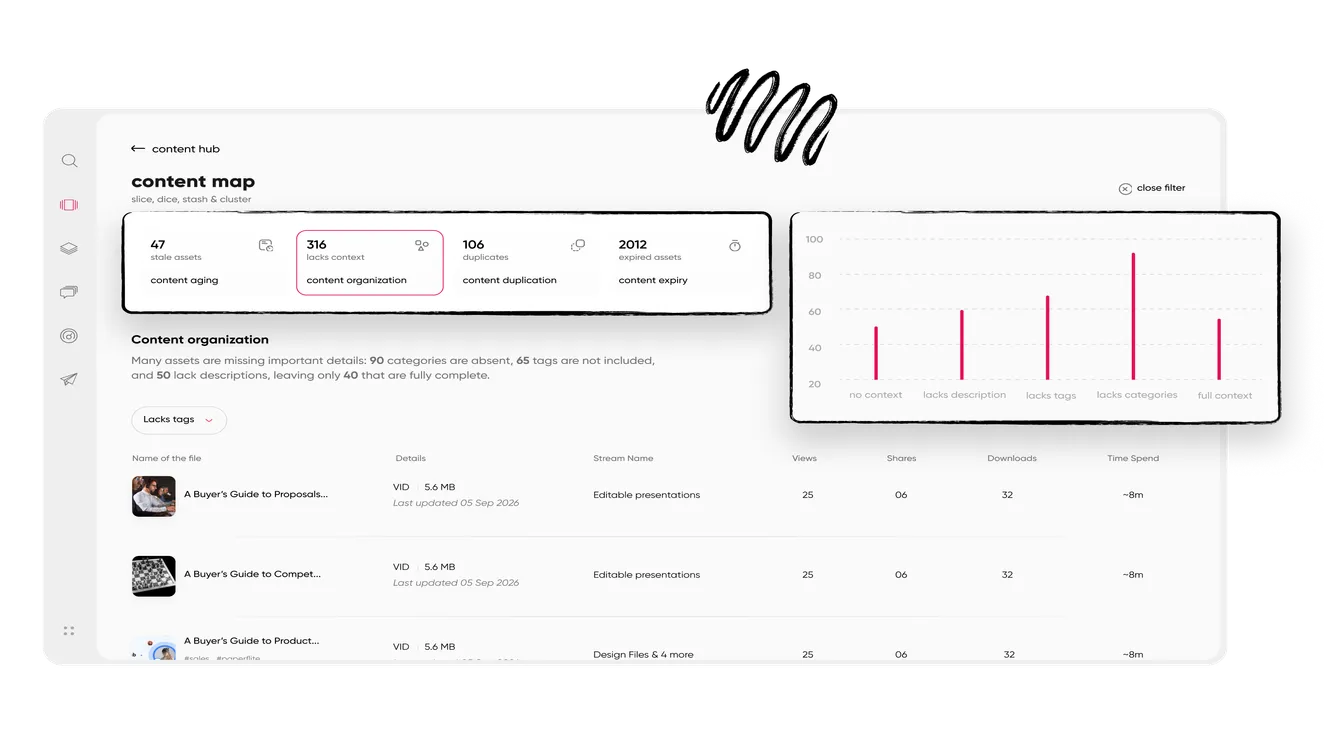
Good context has five traits. It lives in one governed place, so there is a single source of truth. It carries metadata such as persona, buyer stage, product, and region, so retrieval is precise. It has retirement rules, so old material leaves circulation on a schedule. It has named owners, and it has engagement data attached, so the agent can tell which asset buyers actually spend time on and which one just looks good in the library. That last trait is where content intelligence pays off, because an agent that sees which assets move deals will recommend better than one that ranks by recency alone.
A governed content hub gives agents one folder structure to draw from instead of five.
Start with an audit before you switch anything on. Pull your top 50 assets by usage, check each for a current version, an owner, and tags, and fix or retire what fails. Our sales content management guide covers the housekeeping in more detail.
Engagement trends show which assets buyers actually open, a signal agents can use to rank what to surface.
Part 2, Workflows: Decide What Agents Own, Assist, or Avoid
Once the context is clean, you choose the jobs. A simple test keeps this honest: score each workflow on repeatability, risk, and how ready your governance is for it. DealHub describes a similar own, assist, avoid model for revenue workflows, and it translates well to enablement.
Own means the work is repeatable and low risk, so the agent runs it and a human reviews samples. Assist means the work carries high judgment or high impact, so the agent drafts and a human decides. Avoid means the decision pattern is too ambiguous to encode or your guardrails are not ready, so the work stays with people for now. Revisit the sorting every quarter, because a workflow can move from avoid to assist as your governance matures.
Five workflow families cover most of what enablement teams hand to agents.
Prepare. Before a call, an agent assembles an account brief from CRM notes, past conversations, and relevant content. The rep walks in knowing the buyer's context without spending 30 minutes on tabs. Treat this one as assist, since the rep still decides how to use it.
Engage. During the deal, agents recommend the right asset for the stage, package it, and suggest how to share it. Buyer-facing sends should keep a human approval step until you trust the output.
Follow up. After a meeting, an agent drafts the recap email and queues the next action. Internal updates such as CRM notes are a good candidate for owning, while customer emails stay in assist.
Coach. Agents can flag skill gaps, suggest practice, and give managers a weekly summary of where reps need help. Managers still own the conversation, because a person has to read the room.
Improve. Agents answer plain-language questions about adoption and content performance, and they flag assets for retirement. This is low-risk and a good place to begin.
Pick two workflows to start, one internal and one buyer-facing with human approval. Resist the urge to launch all five at once (your future self, reading the audit logs, will thank you). For more on how these pieces fit a wider plan, see our revenue enablement strategies article.
A rep asks the Deal Agent a question from inside the deal, an assist workflow with the human still deciding.
A daily action queue turns signals into a short list of next steps for each rep.
Part 3, Governance: Set the Rules Before the Agent Runs
Governance is the part teams postpone, and it is the part that decides whether anyone trusts the rest. Commentators such as Tim Cortinovis argue that once an autonomous system can contact customers, edit records, or suggest commercial terms, governance stops being security's job and becomes a revenue design requirement. Surveys he cites suggest deployment is running ahead of governance maturity, which is worth verifying against the originals before you quote them.
A minimum viable governance model needs five pieces. Each agent has an identity, so you know which one did what. Access follows least privilege, so an agent reads only what its job requires. Every action is logged, a person can override or stop any agent, and decision rights are written down, so nobody argues about who approves what after something goes wrong.
Add escalation gates on top. List the actions that always need a human: sending anything to a customer for the first time, changing commercial terms, and making claims about security, compliance, or performance. Everything else can run within the limits you set.
Content governance deserves its own line, because agents repeat whatever you feed them. Approved claims, expiry dates, and role-based permissions on who can publish or edit keep the context from drifting. Ownership usually sits jointly with enablement and RevOps, with legal and security as reviewers. Our piece on revenue enablement and revenue operations explains how those two functions split the work.
Role-based permissions control who can view, edit, and publish the content agents draw on.
How to Roll Out an Agentic Enablement Strategy in 90 Days
A phased plan keeps the pilot small enough to learn from.
- Days 1 to 30, set the foundation. Audit your top assets, fix tags and owners, retire stale content, and name one person accountable for the program. Write the escalation gates and the logging requirements before any agent touches a live deal.
- Days 31 to 60, launch two workflows. Turn on one internal workflow and one buyer-facing workflow with human approval, for a small pilot group of reps and one manager. Collect feedback weekly and fix context problems as they surface.
- Days 61 to 90, review and widen. Read the logs, count overrides and complaints, and compare outcomes against your baseline. Expand the workflows that worked, move one workflow between own, assist, or avoid if the evidence supports it, and retire what failed.
The plan is deliberately boring. Boring is what gets you to day 90 with data instead of a rollback.
How to Measure Whether the Strategy Works
Activity metrics such as logins and views tell you the tools are open, not that they help. Move toward behavior and revenue measures: time to launch a campaign or asset, share of deals using current approved content, ramp time for new reps, and deal velocity at the stages you are targeting. We cover the broader set in our guide to revenue enablement KPIs.
Add a few health checks specific to agents. Track the override rate (how often humans reject or rewrite agent output), the escalation rate, and reported accuracy complaints. A rising override rate means your context or instructions need work, and a rate near zero for a buyer-facing workflow deserves a second look, since people may have stopped checking.
Adoption and usage analytics show whether reps are actually using the approved content and tools.
How Paperflite Supports an Agentic Enablement Strategy
You can map the three parts onto Paperflite directly. For context, the content hub keeps assets in one governed structure, with tagging and engagement analytics that show which content buyers respond to. Seek, the AI search layer, lets reps ask a question and get an answer drawn from that governed library instead of from a loose pile of files.
For workflows, the Deal Agent lets a rep ask questions from inside a deal, and Nudges surface a daily list of next actions. Managers get a weekly team summary so coaching conversations start from what actually happened. Role permissions sit across all of it, which gives you the governance lever described above.
Seek lets reps ask a question and answers from governed content.
A weekly team summary gives managers a starting point for coaching.
Verify before publish: feature names and behavior in this section (Seek, Deal Agent, Nudges, weekly summary, role permissions) are inferred from the product screenshot registry. Confirm each with Product and make sure no copy implies autonomous actions the product does not take.
If you want to see how this looks on your own content and deals, book a demo and we will walk through it.
Conclusion
An agentic revenue enablement strategy comes down to three decisions made before the first agent goes live: what it knows, what it does, and what stops it. Get the context clean, sort your workflows into own, assist, and avoid, and write the governance rules while the stakes are low.
This week, pick two workflows and one owner, and run the audit on your top 50 assets. For where to read next, revenue enablement versus sales enablement is a good companion if your team is still deciding how wide the program should be.
What is agentic revenue enablement?
It is an approach to enablement where AI agents handle tasks like content recommendations, deal prep, follow-up, and coaching support, working toward goals rather than waiting for prompts. People stay accountable for strategy, relationships, and final decisions. The approach works best when the agents have clean content, defined jobs, and clear limits.
How is agentic AI different from generative AI in sales enablement?
Generative AI produces text or answers when someone asks. Agentic AI observes signals, decides on a next step, and acts inside a workflow toward a goal, usually with approval gates for risky actions. In practice, a generative tool drafts the email while an agent notices the buyer opened the proposal, drafts the follow-up, and queues it for review.
Do AI agents replace sales reps or enablement teams?
No. Agents take on repeatable work such as summaries, routing, drafting, and retrieval, which frees people for judgment, buyer relationships, and program design. Enablement leaders still set strategy and define what good looks like, and managers still coach. Teams that remove the human from buyer-facing steps too early tend to find out through an error that reaches a customer.
What data do AI agents need before you deploy them?
Agents need current, approved content with owners and metadata, plus engagement data showing what buyers actually use. CRM and deal signals add the context about where each opportunity stands. Clean up duplicates, retire stale assets, and tag by persona, stage, and product before you switch an agent on.
How do you govern AI agents used by sales teams?
Give each agent an identity, limit its access to what its job requires, and log every action it takes. Keep a human override in place and write down who approves what. Add escalation gates for customer-facing sends, commercial terms, and compliance or security claims, and review the logs on a regular schedule.
Which enablement workflows should you automate first?
Start with low-risk internal work: content search, analytics questions, CRM note updates, and meeting summaries. Add one buyer-facing workflow, such as a drafted follow-up email, with a human approving each send. Move more work to the agent only after the logs show consistent quality.
How do you measure the ROI of agentic enablement?
Compare a baseline against outcomes such as time to launch assets, ramp time for new reps, usage of current approved content, and deal velocity at the stages you targeted. Pair those with agent health checks like override rate and accuracy complaints. Judge results at the 90-day mark so you have enough data to separate signal from noise.
How do I get started with Paperflite?
Book a demo and bring two or three workflows you want to improve, along with a sample of your current content. We will show how the content hub, search, and deal workflows work together on your own material. From there you can decide which workflow to pilot first.
Frequently Asked Questions
PAPERFLITE'S CONTENT TECHNOLOGY IN ACTION
IT'S EASIER THAN FALLING OFF A LOG
(DON'T ASK US HOW WE KNOW THAT)