BEST AGENTIC AI PLATFORMS FOR REVENUE ENABLEMENT
OCTOBER 23, 2026


Getting this one wrong is expensive in a specific way, and it is worth being precise about how.
The licence is the small part. What actually costs is that the platform you choose becomes the place your approved content lives, which makes it the thing every agent you later deploy is grounded in. Swapping the agents is easy. Rebuilding a governed knowledge layer that six months of output was generated from is not, and neither is a second migration eighteen months after the first one.
So the decision is less "which agents are best" than "which system am I willing to make the source of truth." That is the question this page is built around.
The category is new. The players are not
There is a gap worth knowing about before you start: almost nobody searches for "agentic revenue enablement platform," but nearly every major enablement vendor now describes itself that way. The buyers have not adopted the label. The vendors have.
As of this writing, on their own published material:
Highspot describes itself as "the agentic platform for go-to-market," with role-based and specialised agents running on an engine it calls Nexus. Mindtickle launched ElevateOS, which it calls "the first agentic operating system for revenue enablement." Showpad shipped Genie Agents and an Agent Studio for building them in its Summer ’26 release. Seismic positions Aura AI as an intelligence layer across its Enablement Cloud.
Four vendors, four agentic platforms, one empty search term. The practical consequence for a buyer is that the word "agentic" has stopped discriminating. If every shortlist entry claims it, it cannot be a shortlist criterion.
What "agentic" does and does not tell you
It tells you the vendor has moved past a chat box. Something in the product now acts rather than only answers: it watches a deal, drafts a follow-up, flags a stale asset, assembles a brief.
It does not tell you what the agents are grounded in, which is the thing that decides whether their output is usable. It does not tell you which parts of the funnel they cover. It does not tell you what they are allowed to do without a human, who owns that boundary, or whether anything the agents learn makes the system better next quarter.
Those are the questions the rest of this page turns into criteria.
Seven criteria that separate these platforms
1. What the agents are grounded in
The single most consequential one. An agent generating from a general model with no access to your approved material will be fluent and occasionally wrong, which is worse than visibly broken because nobody catches it.
What to ask: where does an answer come from, is the source shown to the rep, and what happens when the approved material is silent on the question. "Grounded in your content" is now a claim several vendors make, so the test is whether you can see the source attached to the answer rather than whether the word appears on the website.
This is testable in an afternoon on your own material, against any vendor on your shortlist. See how we run it with your content.
2. Whether the agents are specialised or general
One general assistant answering everything is a different architecture from several agents each owning a job. Specialisation matters because the jobs are genuinely different: finding an answer mid-call is not the same problem as watching a pipeline for risk, and a single agent tuned for both tends to be mediocre at each.
What to ask: how many distinct agents exist, what each one owns, and whether they share context or operate in isolation.
3. How much of the funnel they cover
The criterion most buyers skip, and the one that most often produces a second purchase a year later. Most enablement platforms are, historically, sales-side tools: content for reps, coaching for reps, deal support for reps. Their agents inherit that boundary.
If your problem includes demand capture, landing page production or buyer-facing narrative, a sales-side agentic platform will not touch it. What an agentic growth team is sets out the full span, and roughly half of it sits on the marketing side.
4. Approval boundaries and the audit trail
An agent that can act needs a line it does not cross, and that line needs to be yours rather than the vendor’s default.
What to ask: which actions are taken without a human, which require approval, who configures the tiers, and whether there is a complete record of what every agent did. What a sales AI agent should be allowed to do without approval is the longer version of this conversation.
5. Whether the system compounds
Agents observing buyer behaviour generate a stream of signal: questions asked, content that held attention, objections that recurred. If that is discarded, the platform works at launch-day quality forever. If it is written back somewhere the agents read from, the system is measurably better each quarter.
What to ask: is there a single place agents write to as well as read from, and can you see what it has learned.
6. Additive or rip-and-replace
Some platforms assume they become the system of record and everything migrates in. Others sit over the systems you already run. The difference shows up in the implementation timeline and in how much of the value you see in the first quarter.
7. What leaving costs
Worth asking at the start, not the end. Export formats, who owns the metadata you create, and what a migration looks like in practice. Migrating from Highspot is a useful reference for what the work actually involves, whichever platform you are leaving.
How six platforms compare
Each entry below describes what the vendor says the platform covers, drawn from its own published material on the dates shown. These are vendor claims rather than independently verified capabilities, and coverage is not the same as quality. Use them to build a shortlist, then test the criteria above against your own content.
pf1, from the house of Paperflite, runs six purpose-built agents on one shared body of company knowledge: Experience, Lead, Knowledge, Distribution, Deal and Coaching. Its own framing for the arrangement is "Your Agentic Growth Team."
Knowledge is the one the others depend on. It captures what the company knows across the systems already in place, including the processes and selling patterns top performers use but never write down, governs it in one knowledge graph, and serves it back by role, product and market with the source attached to the answer. Anything AI writes is checked against brand, facts and claims before a buyer reads it.
The architectural point is the graph itself: every agent reads from it and writes back to it, so what Lead learns about the topics a visitor explored shapes the deal room Deal opens later, and a question nobody could answer well becomes a gap in the knowledge layer rather than a story told in a pipeline review.
Governance is set by the customer: approval gates, a full audit trail, data residency control, and brand, rules, voice and permissions enforced on everything the agents produce. The platform is designed to be additive, on the principle of "every system you’ve invested in, made more valuable."
An answer returned from the governed library in pf1, with its source attached, which is the test criterion one is really asking about.
Take one slice of your library, ask it the five questions your reps ask most, and see how many answers come back with a source attached. Run it with us and keep the findings either way.
Where it sits against the criteria: strongest on grounding, agent specialisation, funnel coverage and compounding. It is the only platform in this comparison whose named agents extend to demand capture and buyer narrative as well as deal and coaching.
Highspot
Highspot describes itself as "the agentic platform for go-to-market." Its Summer Launch ’25 introduced Highspot Agents in two forms, role-based agents acting as embedded teammates for sellers, marketers and enablement, and specialised agents handling always-on work such as deal coaching, play optimisation and content management, all running on an engine it calls Nexus.
Its Fall Launch ’25 added a Deal Agent, described as an AI teammate embedded in the deal that unifies CRM activity, buyer engagement, emails, meetings and manager feedback, supports multi-turn coaching conversations, and auto-generates Digital Rooms. Also named are a Search Answers Agent for permission-aware answers, a Content Specialist Agent, a Learning Specialist Agent and Custom Agents. Highspot supports MCP and names integrations with Microsoft Copilot, Teams, Salesforce Agentforce and Slack.
Coverage: sales enablement, deal support and learning. The published agent set is oriented to the seller and the enablement team.
Mindtickle
Mindtickle launched ElevateOS, which it calls "the first agentic operating system for revenue enablement" and describes as orchestrating and governing agentic capabilities that coach, guide and act alongside revenue teams. The product page says it is "powered by a decade of rep behavior data" and that its agents are "aware of each other," working together and becoming more intelligent with every interaction.
No individual agents are named on the page. The capabilities described are behaviour intelligence, always-on coaching and skill-building, and agentic support in the buyer interaction.
Coverage: coaching, behaviour change and deal support, with readiness and training as the historical centre of gravity.
Showpad
Showpad’s Summer ’26 release introduced Genie Agents and an Agent Studio in which admins build, configure and publish agents, shipping with six prebuilt agents for manual tasks at each deal stage plus custom agents. A Genie Assistant on iOS lets sellers pick an agent and make voice or text requests, returning only what that seller is permitted to see. A Field Seller Agent produces pre-meeting briefings and structured meeting summaries and syncs to Salesforce, Microsoft Dynamics, SAP Sales Cloud and HubSpot.
Showpad also ships an MCP Server so third-party agents can reach its governed content under existing access controls, with integrations named for Salesforce Agentforce, Microsoft Copilot and Glean.
Coverage: seller enablement, meetings and content governance, including field-sales workflows such as offline capture and meeting summaries.
Seismic
Seismic positions Aura AI as "Seismic’s intelligence layer across the Seismic Enablement Cloud," covering finding answers, meeting preparation, content creation, practice conversations, follow-up and insights from enablement activity. Seismic says Aura AI is "grounded in the organization’s trusted enablement content" and describes it as working on approved content and permissions. It has also introduced Aura AI for Salesforce Agentforce.
No individual agents are branded in its published overview; the capabilities are described as categories working across the enablement lifecycle.
Coverage: content, meeting preparation, coaching and analytics, described as working across the enablement lifecycle.
Dock
Dock sits slightly outside the agentic framing. Its centre of gravity is buyer-facing digital sales rooms and collaborative workspaces rather than a branded agent layer. It appears here because it shows up consistently on revenue enablement shortlists, and because a buyer-facing workspace is a requirement worth scoring explicitly rather than assuming.
Coverage: buyer collaboration and deal rooms.
The criterion most shortlists miss
Look again at the funnel coverage column. Five of the six platforms concentrate on the seller: content for reps, coaching for reps, deal support for reps, governance of the material reps send. That is a coherent product, and for a long time it was the whole category.
It leaves out demand capture and buyer narrative. The pages that bring the buyer in, the experiences they move through before a rep is involved, the per-visitor personalisation, the decision about when to ask for a form. Those jobs belong to marketing, and an agentic platform scoped to enablement does not reach them.
This matters for a buying decision in a practical way: if the brief is "we want agents across go-to-market" and the shortlist is four enablement platforms, the resulting system will cover the back half of the funnel and nothing else. That gap is usually discovered after the contract is signed.
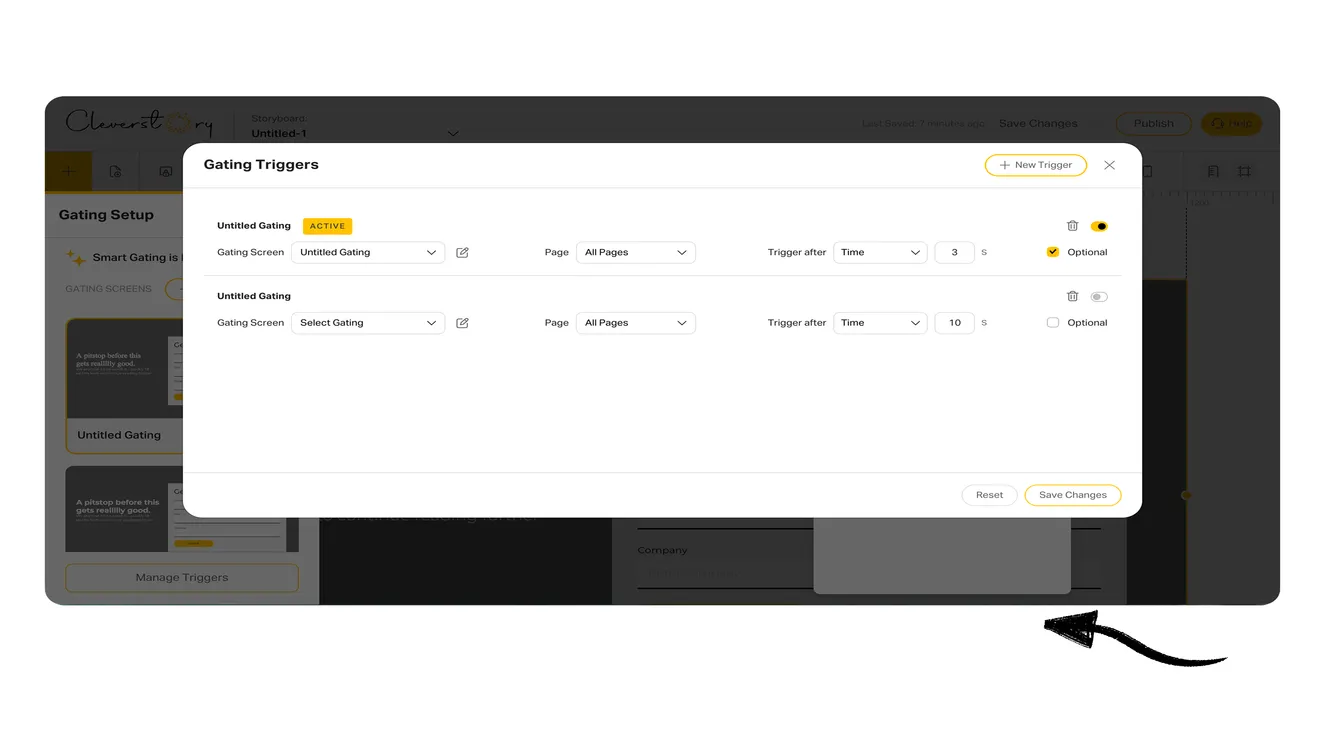
Gating rules in pf1: the demand-side work that enablement-scoped agent layers leave uncovered.
pf1’s Lead agent builds pages around what buyers search, personalises per visitor and holds the form until intent is high. See it run against your own traffic.
How to run the evaluation
Four steps, in this order, because the order front-loads the only decision that cannot be reversed later.
Start with your own content, not with demos. Take one product line or one segment and get it to a state where every asset has an owner, a current version and real metadata. This tells you more about your readiness than any vendor conversation, and every platform on the shortlist will perform better or worse depending on it. What a single source of truth looks like is the target state.
Run the grounding test on real material. Load the same narrow slice into each shortlisted platform and ask each one the five questions your reps actually ask. Check three things: whether the answer is right, whether the source is shown, and what happens when the approved material does not cover the question. This single test separates platforms faster than a feature matrix.
Write the approval boundaries before the pilot, not during. Which actions an agent takes alone, which need a human, and what evidence would move an action from one list to the other. Then check each platform can actually express your boundaries rather than its defaults.
Score funnel coverage against your brief honestly. If the brief includes demand generation, mark the platforms that do not reach it as partial rather than as complete, and decide deliberately whether to fill that gap with a second purchase.
Role permissions in pf1: the controls an approval-boundary conversation turns into once the pilot starts.
Bring the approval boundaries you would want enforced and we will show you where each one is configured, before any pilot starts. Walk through them with us.
Back to the cost of getting it wrong
The licence renews annually. The knowledge layer does not.
Whichever platform you choose becomes the thing your agents are grounded in, which means the quality of everything they produce is bounded by how well that platform governs what it holds. Specialised agents, a shared graph the agents write back to, boundaries you set, coverage that matches your brief: those four are what you are actually buying.
Run the grounding test on your own content before the shortlist narrows. It takes an afternoon and it answers the question the feature matrices cannot.
Which platforms offer agentic AI for revenue enablement?
On their own published material: pf1 runs six named agents on a shared knowledge graph; Highspot describes itself as an agentic platform for go-to-market with a Deal Agent and several specialist agents on its Nexus engine; Mindtickle offers ElevateOS, which it calls an agentic operating system for revenue enablement; Showpad ships Genie Agents and an Agent Studio; and Seismic positions Aura AI as an intelligence layer across its Enablement Cloud.
How do you compare agentic platforms when every vendor claims to be agentic?
Stop treating the word as a criterion and test seven things instead: what the agents are grounded in, whether they are specialised or general, how much of the funnel they cover, who sets the approval boundaries and whether there is an audit trail, whether the system compounds by writing back what it learns, whether it is additive to your stack, and what leaving would cost.
What is the single most important criterion?
What the agents are grounded in. An agent generating from a general model with no access to approved material produces output that is fluent and occasionally wrong, which is harder to catch than output that is obviously broken. The practical test is whether the answer arrives with its source attached, not whether the vendor uses the word “grounded”.
How many agents should a platform have?
The number matters less than whether each one owns a distinct job and whether they share context. Finding an answer mid-call and watching a pipeline for risk are different problems, and one general assistant tuned for both tends to be mediocre at each. Ask what each agent owns and whether what one learns is available to the others.
What does it mean for an agentic platform to compound?
Agents observing buyers generate signal: questions asked, content that held attention, objections that recurred. A platform compounds when that is written back to a layer the agents also read from, so the system is better each quarter. Without it, the platform performs at launch-day quality indefinitely regardless of how much it observes.
How should we run a pilot?
Load one narrow slice of real content into each shortlisted platform, ask the five questions your reps actually ask, and check whether the answer is correct, whether the source is shown, and what happens when the approved material is silent. Write your approval boundaries before the pilot starts, then check each platform can express them rather than only its own defaults.